
Federal Prison Release Paths
BOP manages people serving federal sentences after designation to a federal institution. That differs from U.S. Marshals Service custody, which commonly covers federal pretrial detention, court movement, and transport. A person may leave SCCDOC on a federal hold and enter USMS custody without appearing immediately as a BOP prisoner. Only after BOP designation does the BOP locator become the central public search.
A BOP exit can mean completion of imprisonment, movement to community confinement administered through federal corrections, transfer to another authority, or another change outside an institution. Federal supervision may continue through the U.S. Probation and Pretrial Services system. The locator’s release date and location field should be paired with the federal docket or another responsible source when the exact destination matters.
| Federal stage | Primary source | What an exit means |
|---|---|---|
| Pretrial or transport custody | USMS and federal docket | Not necessarily BOP custody |
| Sentenced federal imprisonment | BOP Locator | Institution or BOP status |
| Released from BOP | BOP result plus docket or supervision source | Exit from BOP, not proof no other custody exists |
| Transfer to another agency | Sending and receiving records | Custody continues elsewhere |
BOP Release Locator Search
The BOP locator covers federal prisoners incarcerated from 1982 to the present. Search by BOP register number for the strongest match. The form also accepts DCDC, FBI, or INS number. A name search can use first, middle, and last name plus age, race, and sex filters. A same-name result should never be accepted without comparing the register number and other identifying facts.
Results can include name, register number, age, race, sex, release date, and location. The release date may change because sentence computation changes, including recalculation associated with federal credits. Recheck the record near the expected date. Save the exact result wording and access date rather than rewriting a tentative date as a guaranteed exit.
- Use a BOP register number when known; otherwise enter the full legal name.
- Apply demographic filters only to separate similar names.
- Compare the register number, age, and other displayed identity data.
- Read location and release date together, then record the exact wording.
- Check the federal docket or receiving authority before describing community release.
The official BOP Inmate Locator is shown below as the appropriate federal sentenced-custody channel.
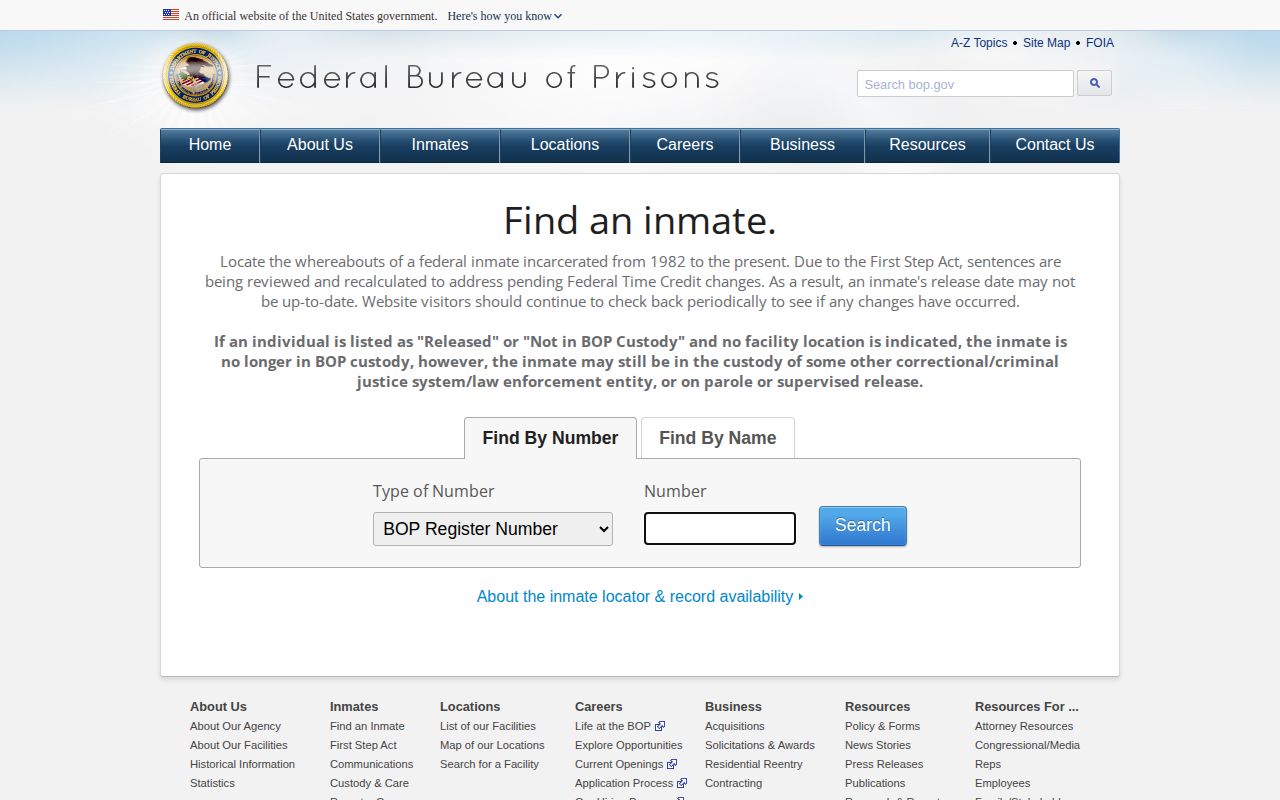
The search interface demonstrates why an identifier-based lookup is stronger than a name alone. It is a BOP system, not a St. Charles County release roster.
Note: A future BOP release date can be recalculated, so it is not proof that physical release has already occurred.
What BOP Released Proves
When the location is shown as “Released” or “Not in BOP Custody” and no institution appears, BOP says the person is no longer in its custody. That statement is exact and useful. It is also limited. The person may be held by a state or local jail, another criminal-justice agency, immigration authorities, or another correctional system. The person may also be in the community under federal supervision.
Use two sources when practical. The BOP result establishes the federal prison custody change. A docket entry can identify the sentence, release order, revocation, or later warrant. A USMS record can document transport or pretrial custody. An ICE locator result may help after an immigration transfer. No single negative search should be converted into a claim that all custody ended.
If the locator shows an old date but the person’s current whereabouts remain unclear, use the register number across the next authorized channel. Preserve the BOP release date as one event in the chain. Do not replace it with a state, county, or immigration date simply because that date is later.
BOP Release Record Requests
The locator is a public status tool, not the full release file. A focused federal records request can ask for historical custody, designation, transfer, or release information that is publicly releasable. State the full name, register number, approximate dates, and the event sought. Ask for an electronic response and for segregable portions if some material is protected.
A federal docket may contain the judgment, sentence, amended judgment, commitment, release-related order, or supervision proceeding. Those entries explain the legal basis. They may not show the precise moment of physical exit. Pair the legal event with the BOP status or agency record rather than forcing either source to answer both questions.
Federal Bureau of Prisons
BOP Locator for public sentenced-custody status
Use the register number when available.
RRM St. Louis
Residential Reentry Management office serving eastern Missouri
It is not a St. Charles County prison.
Federal Court Record
Use the correct federal case and docket
Compare the judgment and later release or supervision entries.
No BOP prison is physically located in St. Charles County. The BOP Residential Reentry Management St. Louis office serves eastern Missouri, but that administrative service connection does not establish that a named person is held in a county facility or at the office itself.
Federal Transfers from St. Charles
SCCDOC holds federal and other-jurisdiction prisoners. A person disappearing from county custody can be transferred to USMS, BOP, MODOC, another county, or ICE. The SCCDOC movement entry should identify the release destination or receiving agency. That is the starting link between a St. Charles County booking and a later federal record.
For a federal transfer, first request or confirm the county movement. Next examine the federal docket. Use BOP only if the person entered sentenced BOP custody. If the matter remains pretrial or in transport, the USMS route is more relevant because there is no public Marshals locator. If immigration custody is possible, use ICE’s separate locator and its limited recent-release coverage.
The county’s 2026 police and federal immigration cooperation announcement does not create a federal prison or ICE detention center in St. Charles County. It also does not prove any named person’s transfer. Facility location, agency training, and individual custody are separate facts.
Note: A county release to federal authorities is a local custody exit, not a community release.
Local Holds Before BOP Custody
St. Charles County’s local booking layer is fragmented. City of St. Charles has a staffed police holdover. Wentzville lists jail and booking. O’Fallon documents municipal booking management. St. Peters uses SCCDOC for confinement under its code. A federal case may begin after one of those short local holds, and a person may never appear in every system.
Start with the arresting municipality if no SCCDOC record appears. Ask whether release occurred from the city unit or whether the person transferred to SCCDOC or federal custody. Then follow the receiving record. This path prevents the BOP locator from being used too early and prevents a blank BOP result from being mistaken for release.
A local court record and a federal docket can also concern different cases or holds. Compare case numbers and custody dates. The strongest chain uses the municipal or county exit entry, the federal custody source, and the relevant court action.
After a Federal Prison Release
Leaving a BOP institution does not necessarily end a federal sentence. A term of supervised release can follow imprisonment and is administered through the federal court system. The BOP locator is not a complete supervision record. Check the judgment and later docket entries for the term imposed and any modification or revocation.
- BOP release
- Exit from Bureau of Prisons custody as reported by BOP.
- Supervised release
- A court-ordered period in the community after imprisonment, overseen through the federal court system.
- USMS custody
- Federal pretrial, transport, warrant, or court-related custody outside the public BOP locator.
- Detainer
- A request or notice that another authority may assume custody.
For a personal or legal need, keep the register number, exact status, release date, date searched, and related docket entry. If another agency appears, document that second source. The result should say only what the evidence proves.
Verify a Federal Prison Release
A sound federal verification uses the BOP result as the custody source and a federal docket, supervision record, or receiving-agency record as the legal or destination source. Conflicting dates are not automatically errors. A court order date, BOP release date, USMS transfer date, and another agency’s admission date can all describe different steps.
Do not average those dates. Label them. If only BOP is available, write that the person is no longer in BOP custody as of the displayed record. Recheck the official source when the result is time-sensitive and ask the responsible agency for an exact historical record when a public display is not enough.